
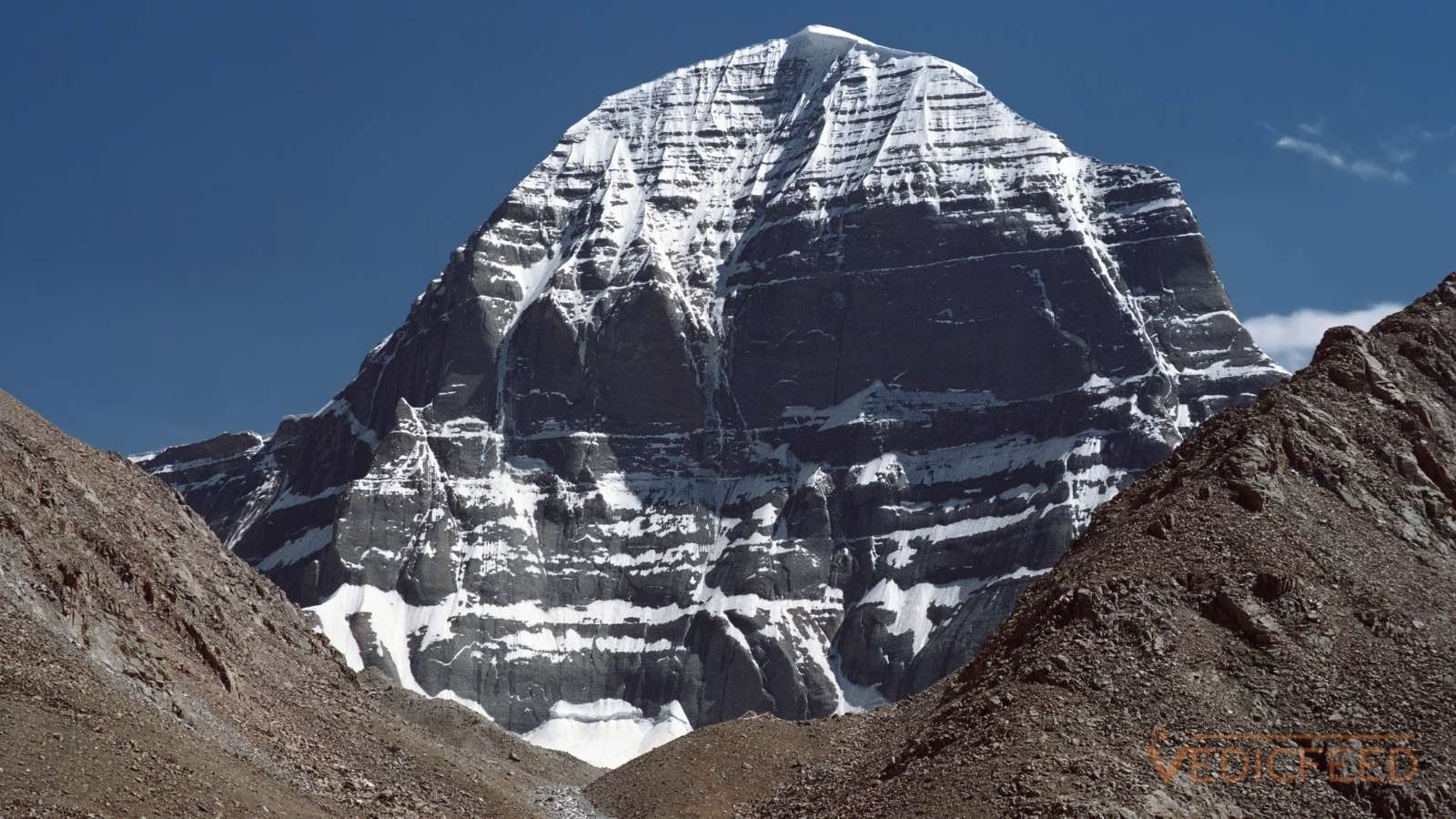
Mountains and spirituality are inextricably linked, especially in Eastern
cultures including Sanatana Dharma, Buddhism, Jainism and Bon, and indigenous
cultures around the world. Through the millennia, sages and saints have sought
out the serene heights of mountains, especially the Himalayas, to meditate,
pray and seek self-realisation. This includes Adi Shankaracharya, Buddha, Rishabhadeva and Guru Gobind Singh ji among others. While the entire Himalayan ranges are considered sacred, Mount Kailash is the the jewel in the crown.
Given that walking and climbing are good for overall health and the fact
that mountains have spiritual, medicinal and rejuvenating powers, our ancestors
had built temples atop mountains across the country — Badrinath, Kedarnath,
Vaishnodevi, Tirupati – to name just a few notable ones. Some of the sacred
mountains themselves are worshipped as Deities and devotees do parikrama of
them — Mount Kailas, Arunachala (Tiruvannamalai), Brahmagiri (Trimbakeshwar),
being prominent among them.
While to Hindus Kailash is the abode of Shiva, Buddhists call it Garu
Rimpoche or precious jewel of snow and look upon it as an enormous mandala, and
the place where Buddha had meditated. As per Jain lore, the first Tirthankara
Rishabhadeva attained nirvana on its summit. According to the Bons, it is a
nine-tiered swastika with immense spiritual powers, where the founder of Bon
religion, Thonpa Shenrab Miwo came down from heaven to spread his spiritual
knowledge.
Mount Kailash is the physical manifestation of the celestial mountain Meru
— Sumeru to Buddhists — the gateway to swargaloka. If one looks at the
Mahameru Yantra worshipped by Shakti upasakas, one can see the striking
likeness between the two. Its pyramidical structure and countless small
pyramid-like hills surrounding it do make for an uncanny resemblance of Kailash
to Meru.
While on Mahameru, according to Balinese Hindu lore, when the Gods found the island of Bali unstable and shaky, they set down the mountain Meru to steady it. It is this Meru that is called Gunung Agung, a sacred mountain which the Balinese consider the ‘Navel of the World’. Pura Besakih, also known as the Mother Temple of Bali — a big temple complex dedicated to the Hindu Triumvirate of Brahma, Vishnu and Shiva – is on its slopes.
The devout believe that a dip in the waters of the Mansarovar lake washes
off one’s paapa. This lake incidentally is the world’s highest freshwater lake.
There is a saltwater lake nearby called the Rakshas, which has no marine life –
as if testifying that good and bad co-exist in this world. There are many
sacred spots, temples and shrines of all religions around Kailash, making the
Kailash-Mansarovar yatra one of the most sought after ones, despite the harsh
climate, high altitudes and steep costs.

Mahameru yantra
The yatris reverentially do parikrama or kora (as the
Buddhists call it) of the mountain. While Hindus, Buddhists and Jains go
clockwise, the Bons go counterclockwise around the mountain. One parikrama of
Kailash is equated to completing one life cycle according to Buddhist beliefs,
while Hindus consider the Kailash-Mansarovar yatra as the dissipation of one’s
paapa.
Since it is sacred for so many Eastern cultures, climbing the Mount Kailash
is prohibited. The only person who has climbed the mountain till the summit is
the 11th century Buddhist monk Milarepa. After coming down, he had
warned the people not to ever climb the peak as it disturbed the God residing
there.
Attempts by mountaineers have either met with failures, even death on the
treacherous slopes. In addition to sudden inclement weather, there have been
recorded instances of inexplicable decisions by mountaineers attempting to
scale Kailash, to take a wrong route or even turn back, and entire expeditions
simply vanishing, never to be found. Whether it was the treacherous snow-bound
steep slopes which are unclimbable, or divine retribution is a matter of
conjecture.
Suffice to say that Kailash is believed to be inhabited by supernatural
forces and anyone receptive to them can imbibe their positive energies. The
following excerpt from Sacred Mountains of the World by Edwin Bernbaum
(University of California Press,1997), explains this beautifully:
A pilgrimage to the mountain, therefore, represents for them a journey
to the very center of the universe–the cosmic point where everything begins and
ends, the divine source of all that exists and has significance. In circling
the peak and paying homage to a vision of Siva or Demchog on its shining
summit, they make contact with something deep within themselves that links them
to the supreme reality underlying and infusing the cosmos itself.
Mt. Fujiyama and Dewa Sanzan:
The Japanese reverence for their mountains is legendary. Both Shintoism and Buddhism have mountain worship in their philosophy. They carry out their worship in different ways, with many of their rituals being associated with their ancestral spirits that are supposed to reside on the mountains. They believe that by being close to them in their most primal form, their energy and hidden powers can be imbibed by mortals.

Mount Fuji
The most famous and holiest of them all is Mt. Fujiyama, a volcanic mountain with its iconic conical snow-capped peak, which is climbed by hundreds of thousands of pilgrims and tourists every year. The Japanese worship it as a god and believe that its volcanic activity symbolises the earth, sky, and fire. It is often referred to as Fujisan or Mr.Fuji! The devout Shinto, Buddhist and numerous other sects believe that ancestral spirits live up the mountain and it is customary for them to do parikrama around the volcano crater at the top. There are hundreds of shrines at the base, enroute, and at the top of Fuji. Today tourists and trekkers far outnumber pilgrims, but that is the way it is in most religious places.
Japan is also home to a unique religion called Shugendo, which is an amalgamation of Shintoism, Buddhism and Taoism. This sect is centred solely around mountain worship, specifically in the forests of Dewa Sanzan mountain ranges. The followers believe that by living with Nature, practising harsh austerities and performing special and secret rituals in the several shrines situated enroute to the summit, they can imbibe the spiritual powers of the ancestral spirits.

Yamabushi elder leading the trainees
The Shugendo practise the enacting of the human life-cycle, as the pilgrim
climbs the three mountains of Dewa Sanzan comprising of Mount Haguro, Mount
Gassan and Mount Yudono. These symbolise life/present (Mt.Haguro), world of the
dead/past (Mt. Gassan) and rebirth/future (Mt. Yudono), with the pilgrims going
through the symbolic ‘death’ of their worldly self to be ‘reborn’ as they enter
the ‘other world’.
Under the guidance of traditional masters of the mountains called Yamabushi,
the seekers dress in their funeral garb and follow the instructions of the
Master implicitly. Their routine is austere and rigid — no brushing of teeth
or washing, the most frugal food, secret and esoteric rituals performed at
various shrines enroute, no phones or contact with the outside world. They walk
in silence only chanting uketamo, which can be loosely translated into
I accept, whenever the Yamabushi priest gives them any instruction. It
is quintessential zen, with the participant living only in the moment.
The Yamabushi experience as it is called, is a 1400-year-old
tradition that is so transformational and life-changing that it has been opened
to non-ascetic and non-religious aspirants in recent years, both from Japan and
around the world. The stint in the mountains spiritually rejuvenates the
trainee Yamabushi, especially after being ‘reborn’.
Uluru:
There are other mountains – both in India and other countries that are
sacred to the devout of different religions and cultures. Some of these
cultures are rooted to the land and are ageless, so to speak, as in the case of
the Aborigines of Australia, who have their own sacred mountain in the form of
Uluru (Big Pebble), the prehistoric monolith which just sits on the
desert floor of Central Australia as if placed there. It is as sacred to them
as Kailash is for Hindus, and Fujiyama for the Buddhists.
Scientists believe Uluru has been around for 500 million years. For purposes
of comparison, the Himalayas are just 30 million and Grand Canyon 70
million-years-old. According to some studies, Aborigines are supposed to have
migrated from South and East Asia thousands of years ago, but other studies say
that they have inhabited the continent from anywhere between 40,000 to 65,000
years ago, which makes Uluru the oldest sacred rock in the world! Climbing it
was sacrilegious to them.
Assuming that a section of the Aborigines had indeed migrated from India, it
is possible that they had taken the customs from the Hindus in the subcontinent
along with them. Indeed there are other things than mountain worship that are
similar to Shaivites of South India, like the white marks on their faces and
bodies akin to the bhasma applied by the former. Another similarity is how they
hold all of creation – land, rivers, animals, birds, trees and mountains etc.,
as sacred.
However, there is a difference in the perspective of Hindus and the
Aborigines about these. While the Hindu worship them as Deities, the Aborigine
considers them the creations of their ancestors in a far-off period in
the past, which is called Dreamtime or Dreaming. The Aborigines hold that their
ancestors created all the things in the world and sometimes stayed on in the
world as one of their creations like a tree or an animal. Some of them do not
eat certain foods for this reason.
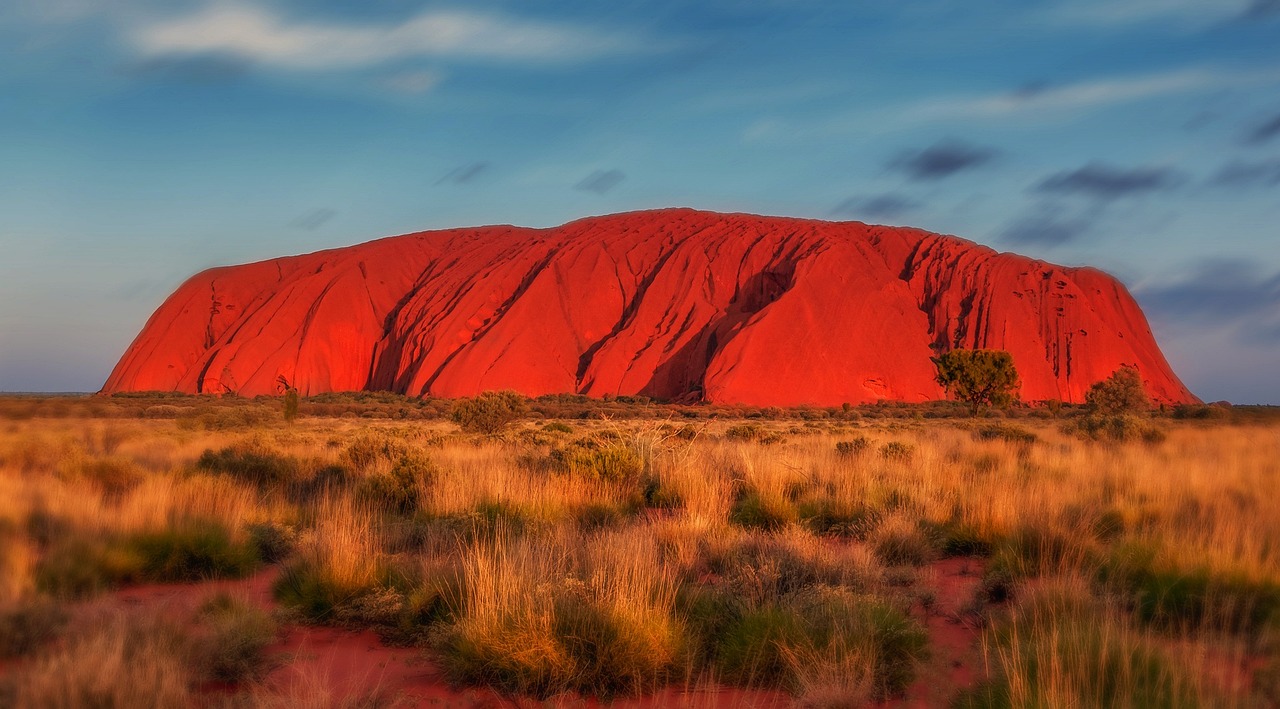
Spectacular view of Uluru at sunset
There is another very distressing thing about Uluru’s history after
Australia was settled as a penal colony by the British. The world’s oldest
living culture was almost decimated by the colonisers when they brought in
diseases, weapons and Christianity to ‘civilise’ them. They were stripped of
the ownership of land they had lived on for over 40,000 years and their most
sacred site of Uluru was named Ayer’s Rock and opened to tourists to climb and
desecrate it.
By comparison, the Kailash slopes are safe from such wanton desecration – in
part, or entirely due to the fact that only Eastern cultures worship and
control it. Yes, even China respects the sentiments of the devotees. But Uluru
being under western colonial powers had no such respect accorded to it.
Though legal and land rights were restored to the Anangus in1985, the
government made them lease it back for 99 years, to continue tourist
activities. An agreement to ban climbing the rock was blithely flouted and even
a chain was fixed to facilitate trekkers. It was as recently as 2019 that the
Australian government eventually relinquished its control over it and restored
its original name of Uluru. And yes, trekking up the rock was finally
banned for good.
Let sacred mountains and religious places remain sacrosanct for the devout.
It is a sacrilege to disturb the divine vibes of such places for temporal
pleasure.
Images: Homepage: https://vedicfeed.com/ Top: https://cpreecenvis.nic.in/Meru: https://www.indiamart.com/
Fuji: https://educalingo.com/Yamabushi: http://cheeserland.com/Uluru: https://pixabay.com/





 The Cybernag
[…] my previous post I had mentioned the concept of acceptance or uketamo (I accept), which is at the core of the […]
LikeLike
I read your latest post on climbing mountains to get spiritually energized with a lot of interest.
It was very informative explaining the practices and importance in Eastern culture of the place of mountains in their spiritual/metaphysical pursuits.. As is always the case, your posts are written after much study and research of available materials.
I do not know much about other religions except Hinduism. Himalayas and other mountains to a lesser degree occupy a high place for spiritual endeavours influenced by the scriptures, strong belief that gods reside there and the presence of holy temples on mountains. The calmness and the solitude at such places could be other reasons for seekers and siddhas to gravitate there to contemplate and meditate without distraction.
I read somewhere that,” the Himalayas are spiritually significant in many other ways. The awe and inspiration these mountains evoke remind us of the power of the divine. They are also symbolic of stoicism and steadfastness. We must, like them, learn to be a ‘Stithpragya’, one with a steady intellect.”
God is otherwise everywhere in energy form and in everyone only to be realized even from home. God is within is the central message instilled in us.
LikeLike
I was reading up more and came across the other Meru that Balinese have in Indonesia. I have added that to the post since. There is so much we do not know about such pursuits by the devout in Hinduism, leave alone other cultures. Mahaperiyava had talked about the connection between Tamils and the Aborigines and now research is proving him right.
You are right about God’s energy surrounding us everywhere, but as in temples where divine energy abounds as compared to our homes, so do mountains radiate much serenity and sublime peace. If we are fortunate and blessed, we can experience them in their respective environs. Whether or not we become Stithpragya is entirely dependent on our dedication,I suppose.
LikeLike
You have done a great amount of research on all the sacred mountain peaks the world over. It’s an outstanding work and feeling you get after reading the entire article in a world of pure soul searching. My daughter is a professional trecker and not very spritual. She is definitely spritual but not very much. But this reading will definitely force her to love visiting the peaks in much more from the divine angle.
Congratulations on doing such a great piece of work. My best wishes.
LikeLike
A comprehensive, engaging and intriguing article. While reading I was thinking whether I could make it to those arduous terrains ever at the same time the idea was so very tempting.
LikeLike
This was a heart filling read dear friend. And you may know why I felt so. Not just it made me feel that Kailash might be calling you, but this article literally took me to the wilderness, faith and spaces of these mountains. Sacred wherever they are.
I would heartily pray if nature graces me to walk, see, imbibe them within me. Thank you for the jewels.
Also a part of this article reminded me of a book i read some years ago, The Krishna Key- by Ashwin Sanghi. He takes on a ride opening up many pores of the mind like doors of a palace.
Thank you. Aum
LikeLiked by 1 person
Thank you Narayan for reading and liking it. Yes, I know what spoke to you in the post. Mountains have a way of getting into your very soul through their ageless wisdom, calm and peace. As for Kailash calling you, I most certainly believe that unless a Deity calls you, you cannot make the pilgrimage. My elder sister was fortunate enough to go on all the yatras including Amarnath, Kailash, Char Dham and more.
I have not read Krishna’s Key. It is indeed good when a bestseller has such an effect on one. I am currently reading your post on Gangotri trip.
LikeLiked by 1 person
That is true, unless a deity calls! And I can actually affirm it because walking Amarnath never crossed my mind even when I was living there in Kashmir for over a year, and one day he just pulled me out of whatever I was doing to walk it with the chief of the shrine board.
I don’t know if Krishna’s Key is a bestseller, it got rightly some under average reviews but it was a book which will give some over the edge informations about history, geography and dharma.
LikeLike