
Hey, I don’t mean the tea/coffee filters we use every day. We need not one, but several of those, and certainly can’t do without them! In fact, please fix yourself a cuppa and sit, before starting to read the post, for a glimpse about masks and filters.
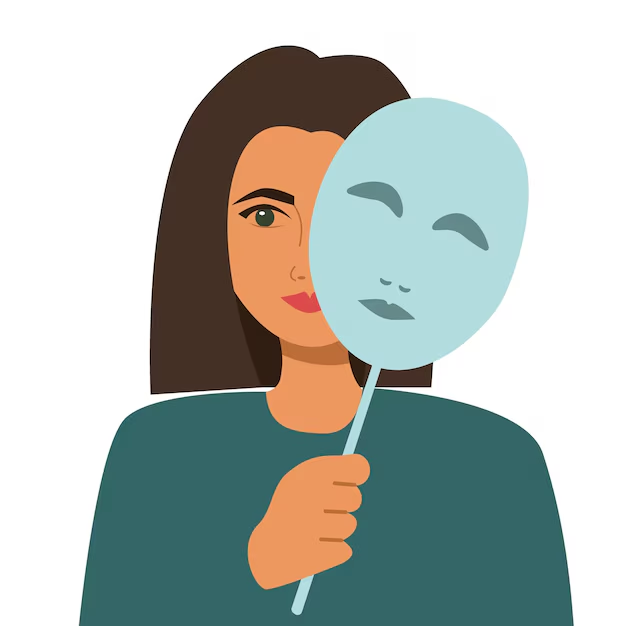
While costume masks hide the identity of the wearer, metaphorical ones help hide the personality of the one wearing them – the vulnerabilities, weaknesses and flaws — to present an acceptable or suitable image to the world. There are any number of such convenient masks to choose from to fit different occasions and situations, and we become adept at switching them at will, giving the impression of being someone we are not, often managing to carry them off well. These masks can be broadly classified into emotional, social/professional, situational and cultural masks.
We do not want to show our feelings and become the objects of pity or scorn from random people. Emotional masks protect the wearer from pity, hurt, judgment or rejection. Don’t we reply, ‘I am fine,’ when someone asks how we are, even if we are breaking inside with grief or anxiety? Haven’t we seen friends and loved ones put on a mask of strength and courage while dealing with a serious illness or facing personal problems? How many times have we suffered through a social event with a mask of interest while being bored to tears? All parents wear masks of strength, hiding their own fear while facing a dangerous situation, to reassure their children.
The social and professional masks help us to get through work life and social interactions, where certain roles demand certain kinds of behaviour. Wearing a mask of quiet efficiency and confidence, even while being riddled with anxiety over a project or presentation is quite common. Some bosses put on a mask of toughness while dealing with their subordinates, even if they are otherwise mild mannered. A nervous candidate at an interview might sport a mask of confidence, and so on.
The above masks are all temporary and situational. For instance, the tough boss might be friendly and joke around with the same subordinates outside the office. The mother who has iron control over her emotions when required, drops her mask to reveal her emotional and sensitive side to the children on another occasion, without creating any conflict in their minds.
Though all masks should ideally come off at some point, some of them are in danger of becoming permanent. This usually happens when someone tries to change their personality with a mask and starts believing it to be their real identity, making it that much harder to remove. Like the weakling who hides behind a bully-mask, or an insecure person who tries to gain popularity and importance by jumping in to help anyone, even though that is not their original nature.
Sometimes masks which do not align with the core values of the person can be harmful. For instance, an honest person who is forced to do something unethical in the line of work might be conflicted. Psychologists call this condition cognitive dissonance. Keeping such masks on indefinitely can play havoc with not only the wearer’s physical and mental well-being but also affect their relationships.
As Carl Jung says, “The privilege of a lifetime is to become who you truly are.” Indeed, it is not possible to form authentic and honest relationships if one keeps a permanent mask on, for whatever reason.”
A psychologist friend once observed: ‘When someone hides behind walls and masks, they are not protecting themselves from hurt and judgement or projecting strength but making their soft core even more vulnerable. It can lead to nervous breakdown or even depression.’
She was looking at me pointedly as she said this. Being a psychologist she had seen through my mask of invulnerability, which I had donned in my teens to protect myself from some harsh conditions at school and college. I was unflappable with it, and it had helped me handle many of life’s challenges, hurts and obstacles. I thought my mask was my strength, but here was my friend telling me that I was only harming myself. Come to think of it, it had often come in the way of forming close friendships for fear of the carefully kept mask slipping and exposing my vulnerability. There were times when all I wanted was throw it off and feel validated for who I was. That day I had decided that I needed to work on unmasking.
However desirable it might be, unmasking can have serious repercussions. Those with evil intent sporting a genial mask should be unmasked mercilessly to expose their real self, but others, who are languishing behind their forced personas need to be careful while unmasking. It is best done gradually with someone we can trust, who is non-judgmental and compassionate. It is not easy or even wise to suddenly and indiscriminately reveal our true selves to the world if we are not ready to face the consequences.
Well, so much for masks. Coming to filters, they are the ones we use to look at, hear or feel anything – the communication filters, in short. These are the brain’s gatekeepers, which pass information through certain filters, much like tinted glasses that colour the world around us and create a perceived truth.
All filters are not bad. There are some ‘good’ filters too, which are prompted by sensitivity, etiquettes, respect, nationalism, and socially acceptable behaviour, which help us listen, speak, and see positively. It would therefore not be right to say that one should remove all filters while interacting with others, including communicating at different levels. Just as some machinery require mufflers, silencers and such, to reduce the noise, vibration and danger, we all need to necessarily use filters in our daily lives. But the choice of the filters is entirely in our hands. For instance, when we interact with elderly people, especially in the family, we need to have certain filters in place – patience, understanding and compassion, for instance, to make for meaningful and respectful communication.
On the other hand, the negative filters, which are our prejudices, preconceived notions and presumptions among others, do just the opposite, creating negativity, chaos and distrust. These filters are influenced by many factors, among which are past experiences or trauma, social norms and culture, emotions, core beliefs and values, negativity bias, etc. Whether they are emotional, ideological, political or cultural, these filters show us the world through them, creating perceptions that align with our beliefs.
Filters also depend on our personalities. For example, some of us may be timid and have the fear filter being more active, sifting everything through that. Everything looks dangerous when viewed through the fear filter. By passing any information or experience through one of more of these filters, they are made acceptable to the brain. The result is a distorted reality, making our perceptions biased and unfair. Psychologists call this process cognitive distortions, where the person focuses only on the negative aspects of a fact by downplaying or dismissing the positives.
Ever noticed how news today is all about gloom and doom, disasters, violence, war and negativity? That is because it is human tendency to focus on the negative more than the positive, which is why sensationalism and negativity sell. Media algorithms are set to serve only negative news, thereby strengthening the filters and biases further. There is even a word for it – doomscrolling.
Have you noticed how news is absorbed differently by people with different mental filters? Like tinted glasses that colour the world around us, the mental filters – whether emotional, ideological, political or cultural — show us the world through those filters, distorting the truth. So even if we have facts staring at us, we are ready to only believe what our filters let through. That is not only undesirable but also dangerous. All the conflicts we see around us, whether personal, political or religious, are the results of these biased truths that our brains constantly consume.
To see the real world, it is important to keep an open mind, removing any kind of filter which affects our perception. Gradually the distorted truths will dissolve, leading to both internal and external peace. Likewise, one should use as few masks as are strictly essential and never wear a personality-altering mask permanently. That is the only way to get as close to our authentic selves as possible, living lives without internal and external conflicts..
Images: Homepage: https://stock.adobe.com/ This page: https://www.freepik.com/





 The Cybernag