
Hanuman Jayanti is celebrated as Hanumat Jayanti on Moola Nakshatram/Amavasya during the month of Margazhi/Margashisha/Dhanurmas (Dec-Jan) in Tamil Nadu. It falls on 30th December in 2024. Most often the nakshatram and Amavasya coincide but when they don’t, Amavasya is taken as the day of celebration. In the northern parts of the country, however, it is celebrated during Chaitra Purnima, which falls during April. There is another Hanuman Jayanti too, celebrated in some parts, a day before Deepavali. This is the day Sita had conferred the boon of immortality on Hanuman, when he had gone to Lanka in search of her. There are regional variations both in the dates and ways of celebration of Hanuman Jayanti. You can read about them here.
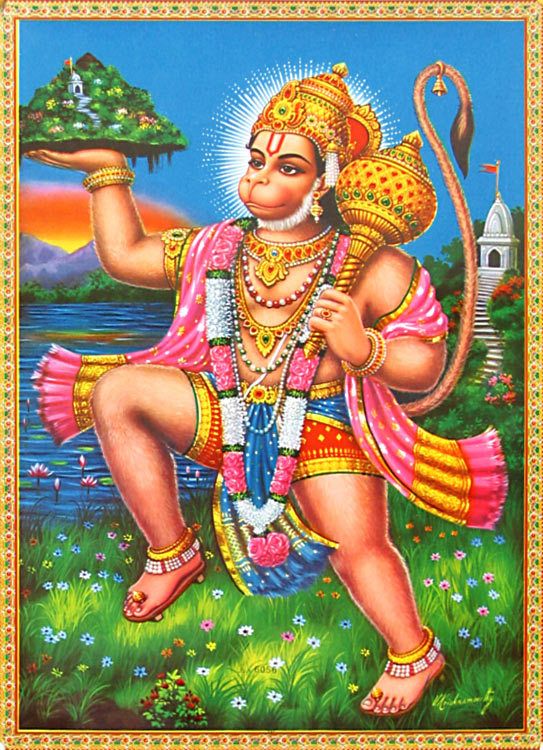
The tradition of vada mala:
One of the traditions of Hanumat Jayanti in Tamil Nadu, is the custom of offering garlands made of vadas to the Deity in temples and homes. In many temples, when the murti is large, the number of vadas goes into thousands. The Namakkal Hanuman temple with its immense murti of over 18 feet is offered a garland of one lakh eight vadas during this festival! Suchindram Hanuman temple is another one with a towering murti. At homes, depending on the size of the picture, we offer garlands made of a multiples of nine vadas. The special vada for this purpose is traditionally made of whole black urad in temples and even many homes, flavoured with pepper and salt. It is thin, crisp, and keeps for several days, unlike the regular medu vada, making it ideal for taking to other cities and even overseas as prasadam. Betel leaf garland is another offering made to the Deity on this day, along with special naivedyams, along with the vadas.
The picture of Hanuman carrying the Sanjeevani parvat is there in many devout Tamil homes. It is customary to apply a dot of chandan on the tail of this image, starting with the base, going round the image and ending it at the forehead to fulfill a wish or vow. Once it is complete, garlands of vadas, along with sweets and other naivedyams are offered.
This post has taken off from Hanuman Jayanti, but I have tried to cover a lot of information about this great Rama Bhakta, who is believed to come to the aid of Rama’s devotees, the moment Rama Nama is chanted.
Hanuman, the supreme Rama Bhakta:
यत्र-यत्र रघुनाथकीर्तनं तत्र-तत्र कृतमस्तकाञ्जलिम्।
बाष्पवारिपरिपूर्णलोचनं मारुतिं नमत राक्षसान्तकम्॥
Wherever Rama’s praises are sung, and His name chanted, Anjaneya is present with his palms folded in prayer, tears flowing from his eyes.
This is why it is customary to keep a vacant asana with offerings for Anjaneya whenever Ramayana parayanam is done. We are living in Kaliyuga where we might not be able to see Hanuman occupying that seat in His sthoola (physical) form, but we can be certain that he would be present in His sookshma (subtle, abstract) form, when Rama’s glories are recited with devotion.
There are times when he is present in the physical form too. I had the privilege of witnessing one such incident, though it was not Ramayana recitation but a Bhagvat saptah – no matter, because it was Hari’s story after all! It happened nearly two decades ago, when I was a participant in the Bhagvat Saptah at Dayanand Ashram, Rishikesh. As we devotees sat and listened to the narration, there was a simian in the audience too – a big langur who sat at the window, seemingly listening in rapt attention, devoid of any antics that they are known for. According to regulars, it was an annual occurrence during the saptah though they were not sure that it was the same one.

Sceptics might dismiss this as a coincidence, especially in an ashram that has hundreds of the simians, but believers, including me, could only see Hanuman in that devoted vanara who sat through each session!
The bhakti and devotion of Hanuman to Rama is so intense that it is enough to sing the praises of Hanuman to get the Grace of Rama. Hanuman Chalisa sums this truth up in the couplet:
तुम्हरे भजन राम को पावै l
जनम-जनम के दुख बिसरावै ll
— Worshipping you is dear to Rama and will remove the sufferings of several lifetimes.
Isn’t it said that when one is immersed in God, He hovers around to protect His devotees?
It is believed that by singing the praises of Hanuman one can overcome the ill-effects caused by Shani. In many temples in the north, we can see Hanuman trampling Shani under his foot.
Anjaneya, the Chiranjeevi
He is the only immortal in this mortal world – Chiranjeevi Rama bhakta, who was granted the boon by Mata Sita herself, when he took Rama’s signet ring to her in Ashoka vana. He is constantly looking for the sound of Rama nama. So when we chant Rama’s name, we are assured of the presence of Hanuman near us, protecting his beloved Rama’s devotee! His love for Rama nama is so great that when at the end of His avatar, when Rama wanted to take him along to Vaikuntham, Hanuman asked whether the Lord would be Rama in Vaikuntham too. When Rama smiled and said that he would be Vishnu and not Rama, Hanuman declined the offer, preferring to stay on the Earth where he would be assured of hearing Rama’s name being chanted!

There are the many versions of his birth according to different puranas and folklore, and amid crude jibes about His having several fathers, all versions assert that He is an avatar of Rudra (Rudraroopi) — the 11th incarnation of Shiva. Kesari and Anjana Devi pray to Shiva to grant them a child. The pleased Lord tells them that He Himself would be born to them through the help of Vayu.
The collaboration between Vishnu and Shiva to annihilate asuras is related in many puranas. I had recounted the story of how Vishnu had become the arrow, which Shiva had released from his bow to destroy Tripuri and its ruler Tripurasura in an earlier post. In Ramavatar too, Shiva had to be present – and He was, in the form of Hanuman, the eternal Rama bhakta.
While Hanuman played a vital role in Ramayana eliciting the sobriquet of रामायण महमालारत्नं (Ramayana Maha Maalaratnam – the gem in the wonderful garland of Ramayana), He was there in Dwapara Yuga too. Arjuna’s chariot, driven by Krishna during the Mahabharata war sports the image of Hanuman in its flag. And of course, He is present in Kali Yuga too, everywhere Rama’s bhajans are sung.
Hanuman and Suvarchala
As I said earlier, Hinduism is replete with puranas and their various versions. Embellished by upa-kathas and folk versions prevalent in different parts of the country, it makes for a rich tapestry of history. For instance, while we know Hanuman to be Aajeevana Brahmachari (eternal celibate), do you know there are versions of the puranas and other lore, where he is married? Read about it here and here
There are temples in Tamil Nadu and Andhra, where He is worshipped with his wife Suvarchala, the daughter of Surya. As often happens, there are variations in the narration as to why and how Hanuman got married to Suvarchala. Let us take the one mentioned in Parashara Samhita, written by Parashara Maharishi, the father of Veda Vyasa.
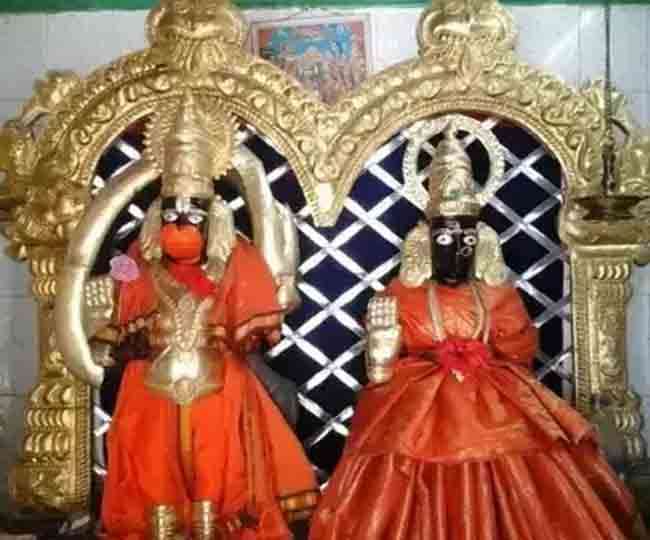
In addition to being a great warrior with immense prowess, thanks to the many boons he had received from the Gods, Hanuman was also a great scholar. Most of us have heard of the story of baby Hanuman leaping into the sky to swallow the Sun thinking it to be a giant fruit. It was the same Surya who became Hanuman’s Guru when he grew older. Hanuman mastered all the scriptures but when it came to the Nava Vyakaranas (Nine Grammar Works), Surya Dev was unable to teach them, since they could only be learnt by a grihastha (householder), and Hanuman was a Brahmachari.
Seeing how keen Hanuman was to learn the nine vyakaranas, Surya suggested that he marry his daughter Suvarchala, who was created from his luminescence, so that he could complete his studies. When Hanuman protested that his vow of Brahmacharya would be broken if he married, Surya reassured him that he would remain a Brahmachari, as Suvarchala was also a Brahmachairni and would be immersed in her tapasya. There are temples for Hanuman with Suvarchala, both in Andhra and Tamil Nadu.
Makaradhwaja, the son of Hanuman
While Hanuman’s consort is known to some in the south, very few might have heard of Hanuman having a son. There is a sect in Gujarat called Jethwa, which traces its lineage to Makaradhwaj, the son of Hanuman. In fact, the sect worships both Hanuman and his son.
The lore has it that when Hanuman was returning from Lanka after burning the golden city, a drop of his sweat fell into the ocean which was swallowed by a fish. This fish was taken to Patal Loka, ruled by Ahiravana, Ravana’s brother, where a baby vanara was found in its stomach.
Now, Ahiravana had abducted Rama and Lakshmana from Rama’s camp in the battlefield one night through his mastery of maya. Meanwhile Makaradhwaj had grown up to become the guardian of the gates of Patal Loka. Father and son meet during the Ramayana war, when Hanuman goes to Ahiravana’s kingdom to rescue Rama and Lakshmana.

When Hanuman wonders how a vanara is guarding the asura’s kinddom, Makaradhwaja relates the story of his birth and how he was the son of Hanuman. But being loyal to their respective masters, the duo fights it out. Hanuman defeats Makaradhwaja, kills Ahiravana, and releases Rama and Lakshmana. Makaradhwaja is subsequently installed as the ruler of the kingdom.
While researching and writing this post, I realised what a puny effort I was making to recount the magnificent tale of Hanuman. There are so many forms of this great Deity, and ways of worshipping Him across the country. In many parts of North India, women are not allowed in Hanuman temples. If I had to write about them all, I would need to write not a post, but a book! The sheer volume of academic hair-splitting about the various versions pertaining to the Deity is mind boggling. It is wrong to interpret divine stories with a human perspective. We should not treat deities like humans. It is wrong to speak about Guru and God as if they are ordinary humans with worldly needs. Only when divinity in them is seen and respected, and their stories read with faith, the deepest secrets hidden behind the stories begin to be understood by the mind. There is no other way to understand the hidden secrets behind the divine stories.
And yes, sometimes we are blessed with the manifestations of His avatar too. I would like to recount an endearing anecdote from my life. We were on a safari in the Sariska wildlife sanctuary trying in vain to spot a tiger, when the car developed some problem. Fortunately it was very close to a small village and we got out to stretch our legs and have a cup of tea. There was this Hanuman temple with lots of monkeys around. We were told not to keep any small item in our hand, that could be snatched. We bought some laddoo prasad and I was holding one in my hand, after eating a bit of the prasad. Suddenly I felt it being removed from my hand. At first I thought it was one of the boys, but soon realised that it was a monkey! It was as close to the Deity Himself partaking of the prasad as could have been!
जय बजरंग बली!
Images: Top- https://www.dollsofindia.com/ Singing- https://x.com/ With Suvarchala – https://www.jagran.com/
Mahabharat – https://www.malaysiahanuman.com/





 The Cybernag
The blog is so exhaustive that one gets so much involved in the kathas as mentioned. Rightly said that if you go more in details you have write a full book on it. But whatever you have collected the information and put it in the blog….. it’s commendable. Congratulations and my best wishes to you. Please keep it up.
LikeLike