

As the day of the प्राण प्रतिष्ठा (Prana Pratishtha) of Ram Lalla at the Ram Mandir in Ayodhya draws close, millions of Hindus around the world are charged up with divine fervour. Those of us who are living in such times are truly blessed to witness this sacred event. When Rama is in our hearts, in every particle of Creation and, in our very souls, no amount of negative publicity being drummed up against the consecration can take away or even reduce the divinity, glory and joy of Ram Lalla’s return home! Jai Shree Ram!
I have updated and am sharing a post from my archives on the glories of Rama and Rama naama and my personal experiences with the Divine naama.
Rama naama has been imprinted firmly on my subconscious since early childhood, having been surrounded by it through the day. No, I was not living in any ashram or temple and yet had it reverberating around me, as you will see later in the post. While there are other mantras, some simple, others difficult and yet others to be given to you only by a Guru, this one is accessible to everyone, and is so simple that even a child can chant it with ease. Simple it might be, but it is no ordinary mantra — it is the Taraka Mantra no less, which can take one across the very oceans of worldly existence.
There are any number of stories in our puranas that tell us that Rama naama is more powerful even than Rama Himself! One of them is about how the vanaras, led by Hanuman and others threw big boulders inscribed with Rama’s name into the ocean while building the bridge to cross to Lanka. Those with Rama naama floated, while those which didn’t have the inscription sunk.
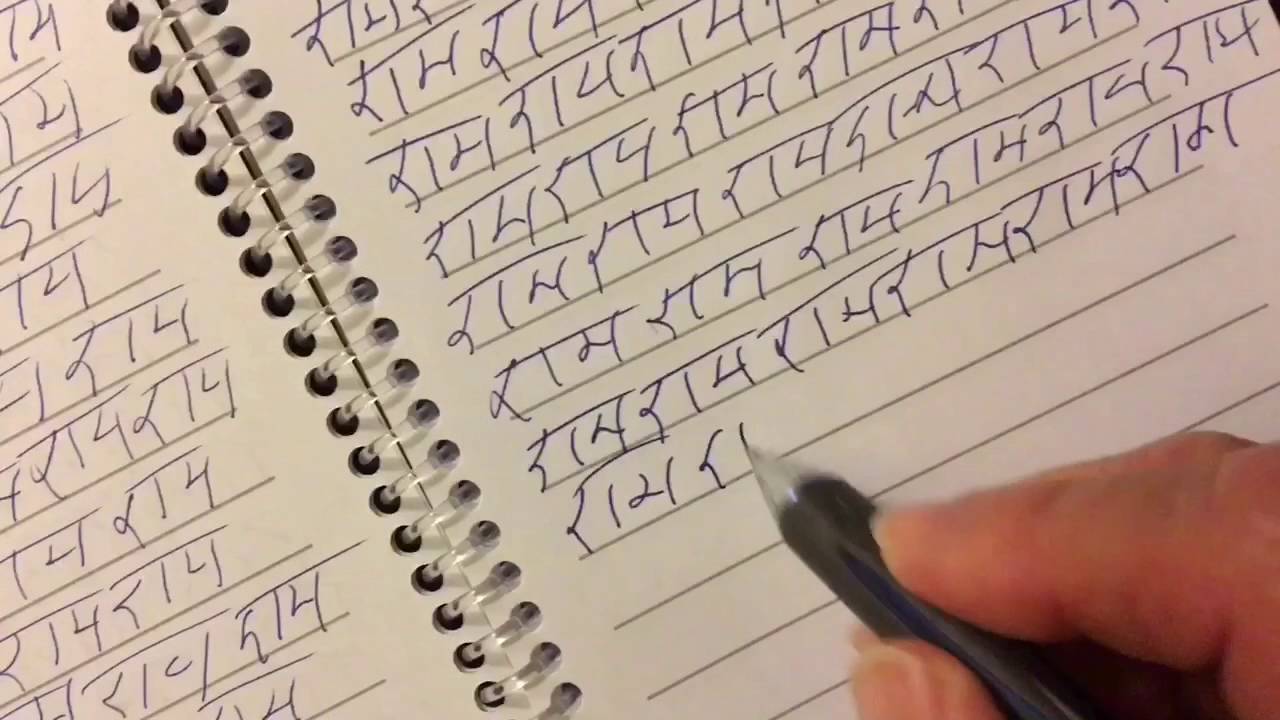
During my younger days I remember how the elders and even youngsters wrote the beautiful naama in notebooks diligently and with great faith, and offered them in temples as one offers flowers. My parents must have written it several lakh times during their lifetimes. The naama could be Sri Ramajayam, Ram Ram, Jai Shree Ram or Sitaram, in any language. Ashrams in Haridwar, Rishikesh, etc., give empty ruled copies for the inmates to write Rama naama. It is considered a form of worship. I have experienced the calm it induces – the rhythmic strokes on paper as the names add up.
There is a verse in the Vishnu Sahasranamam phalashruti, where Parvati asks Shiva how to easily get the full benefit of chanting the 1000 names of Vishnu (Sahasranamam). Shiva replies:
श्री राम राम रामेति रमे रामे मनोरमे
सहस्रनाम तत्तुल्यं श्री राम नाम वरानने
It means that chanting the above verse just thrice is equivalent to chanting the entire sahasranamam.
None of the other nine Avatars of Vishnu, nor any other Deity’s name have such power except that of Sri Rama!
Not only that, but wherever Rama’s praises are sung, and His name is chanted, Hanuman is present with his palms folded in prayer, tears of devotion flowing from his eyes. This is why whenever Ramayana parayanam is done, it is customary to keep a vacant asana with offerings for Anjaneya. It is believed that Rama is pleased with those who chant Hanuman’s praises.
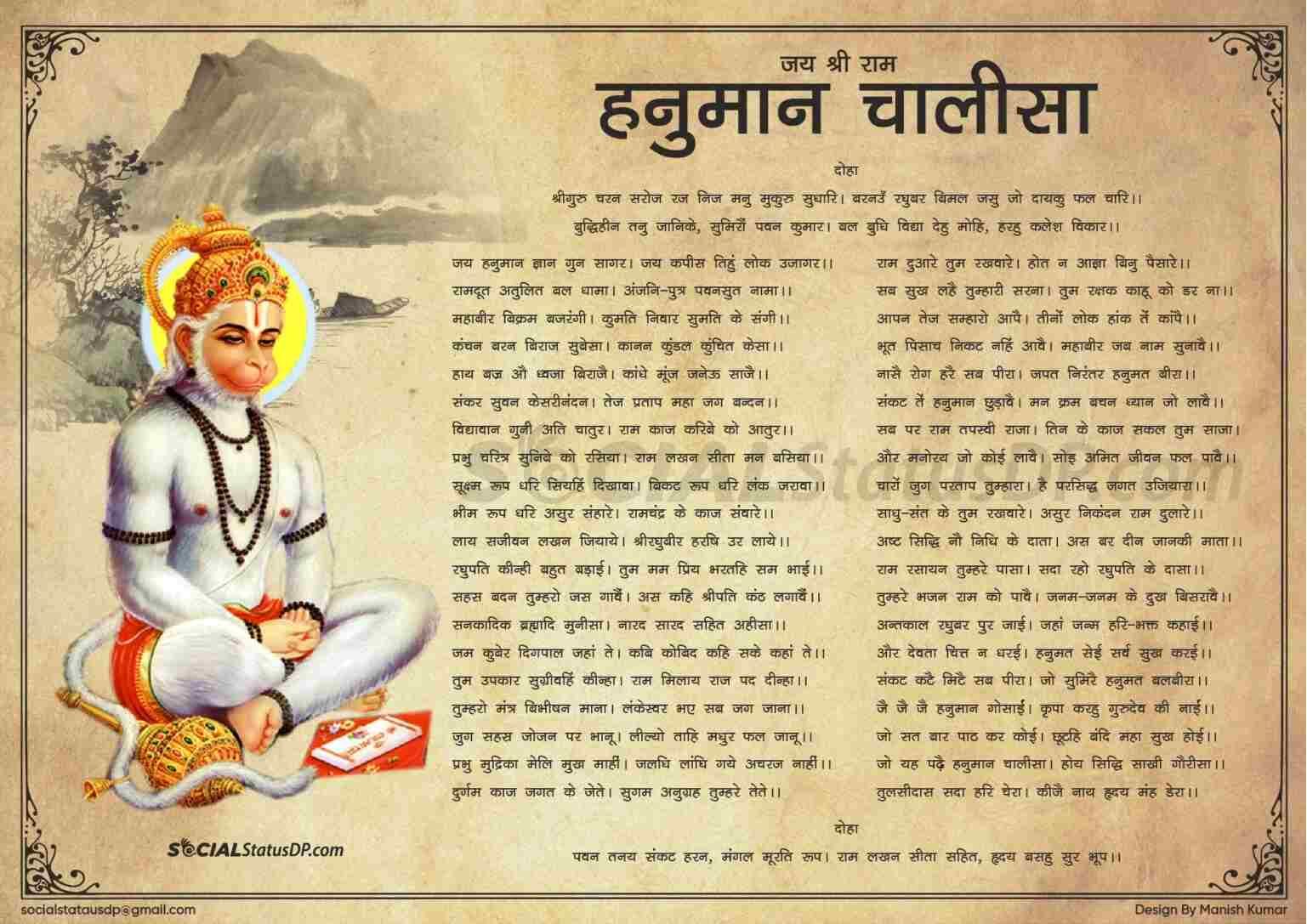
तुम्हरे भजन राम को पावे जन्म जन्म के दुख बिसरावे says Tulsidas in Hanuman chalisa.
(Singing your praises will get the devotee Rama’s blessings to remove sorrows).
It is the spiritual equivalent of ‘Buy 1 Get 1 free!’ if I may be pardoned for my irreverence!
Reams have been written about the significance of Rama naama and the efficacy of chanting it. But what if it was chanted unconsciously as part of daily life? Remember me telling above that I was surrounded by a mantra?
- Not till long ago was Ram Ram, the accepted form of greeting one another in the northern parts of our country, and even today, it can be heard in rural areas and small towns.
- At home we heard it all day: ‘Appa Rama!’ – called out by Mother and Father through the day.
For them, it was the equivalent of taking a deep breath, a pause to throw off mental and physical fatigue. Father would add, ‘Amma Seeta!’ I have not heard anyone else do that, except perhaps the saint poet Tyagaraja. ‘Seetamma maayamma, Sri Ramudu maa tandri (Seetamma is my mother and Sri Rama is my father), he sang.
- My maternal grandfather used to punctuate his incessant pacing during most of his waking hours with chants of ‘Hare Ram!’
- And then there was my beloved eldest brother, who was named Kayanaraman, shortened to Rama/Ram by the family members and friends, which meant that everyone chanted the divine name throughout the day on the pretext of calling or referring to him.
Our ancestors saw the wisdom in naming children after our Deities, which meant that one chanted their names without one’s volition. Every family has a family Deity or Kuldevata (kuladeivam), and often — especially in the south — children are named after them even today. In large families of yore, it was common to have names of several Deities — Ram, Shankar, Lakshmi, Krishna….and the many variations of these names reverberated in the homes. Rama’s name however, is universal. He is the ishta devata, a beloved Deity of millions of Hindus the world over.
Little children are told the stories of Krishna and His Leelas as they are full of action, adventure and mischievous behaviour that are identifiable to children at that age. I only have vague memories of my paternal grandfather, but I remember the stories of Krishna he told me from a Geeta Press (Gorakhpur) ‘picture book’. He told them in Tamil, making up his own narration, since the book was in Hindi. I still have that book, faded and yellow with age. The exploits of Krishna were no doubt interesting, and he was a hero in my little eyes, but at six, it was Rama who appealed to my emotions.
This was thanks to the younger of my two elder brothers, who narrated the stories from the Ramayana as I lay seriously ill in bed. The emotional appeal of Rama’s struggles and how bravely he dealt with them made me His eternal devotee. He was —
- a dutiful son who loved his parents enough to honour their wish.
- a son, who didn’t hold any grudge against his stepmother and father for sending him to the forest.
- a brother who loved his younger brothers dearly and unconditionally.
- a Maryada Purushottam who showed by example how a man should lead his life.
- a devoted husband, who strictly observed eka patni vrata.
- a great friend to Sugriva.
- a dharmic and just ruler who set the ideal of Ram Rajya that is synonymous with good governance even in Kaliyuga……..
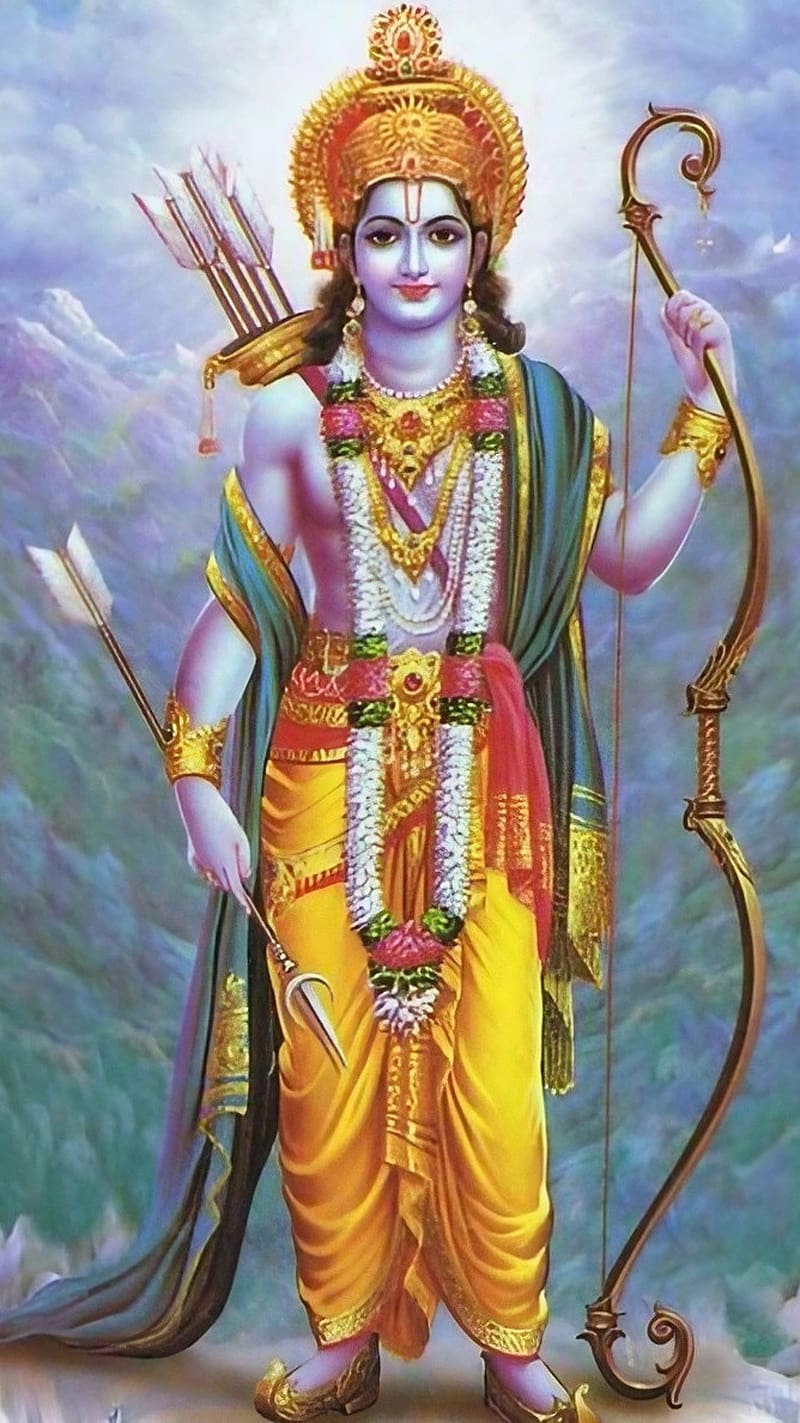
Little wonder then that Rama became my ishta devata and chanting His name came naturally to me. Over the years it is Rama naama that has come to my rescue whenever I have needed support – during my loneliest hours, the most confusing and terrifying moments when I could turn to no one. Suffice to say that I felt benign Presence around me the moment I called out His name, and felt protected from any danger, tangible or intangible. He always appeared in my mind’s eye with His bow and arrow and a serene smile on His face. Till today, this is the image that I conjure up when I need a comforting presence around me.
Chanting ‘Ram Ram’ became my cure-all at a young age. It was many years later during my high school when I had joined a convent school, that I heard from the nuns and fellow Christian students about not taking God’s name in vain; about blasphemy; about us all being sinners and more.
While the other points didn’t bother me much, I just couldn’t wrap my head around the one about ‘not taking God’s name in vain’! I mean, Rama and Krishna and other Deities were my friends and family, whom I called upon for everything and sometimes even nothing! Chanting the name of Deities is the simplest form of worship for Hindus, especially in Kaliyuga. I am glad that it did not stop me from calling upon my Rama when I needed any help.
At a difficult time of transition for a teenager the added conflict of faith and beliefs had torn me up. In the following decades of endless floundering on the tumultuous waves of rituals, devotion, and life itself, I finally found my way. But that is another story.
Coming back to the Pran Pratishttha, let us welcome Ram Lulla home with flowers, diyas, sweets and lots of firecrackers on January 22, 2024 – a second Deepavali for all of us!
Jai Shree Ram!
Pics: Ram Ram writing: curvetube.com Sri Ram: https://www.peakpx.com/





 The Cybernag
[…] a kid, I called upon Rama to come and help me out of my troubles. I have recounted them in my post here. The image of Rama as the protector is so indelibly etched in my mind’s eye that even today, I […]
LikeLike
[…] We might have got used to such indignities today, but back then, it had hit us smack between our eyes. The very thought of someone publicly defiling our beloved and sacred Deity was like a physical blow to us, who lived and breathed Rama’s name. […]
LikeLike
You know ma, this post had such a calming effect on me, almost like listening to you speak! My grandparents and now my parents followed/follow this tradition of calmly writing 100 SriRamaJayams a day. It never made any sense to me then as a kid but now I have begun to appreciate the calming effect it must have brought them following this soothing routine. ‘Appa Ramachandra’ is a sigh that my grandma used to utter everytime she heaved about doing her chores. This post truly evoked some nostalgia !
LikeLike
Thank you Kala! It made me go back in time and relive the moments, which is why I had penned the thoughts down. We do have variations of the call sent to Rama. My mother used to say, ‘Shappa, Rama!’ which was just ‘Shhhh Appa Rama!’ when she was too tired! I have written Srirama Jayam as a girl, but don’t anymore. Perhaps I should begin again.
LikeLike
As I have said to you often, I have not had the kind of rituals and ambience while I was growing up as you’ve had. No deity was ever a part of my emotional landscape. If I was petrified of the dark. I shivered in my shoes all by myself. 🙂
Your point about blasphemy is so true. Thank goodness our view of Divinity is not the same as that of Islam or Christianity. We’d have had a thin time of it if we had!
Loved this post!
LikeLike
We have the exact opposite of the blasphemy dictum of the Abrahamic religions. Jews don’t even say ‘God’. And here we are told to keep chanting! And how I love that! As for you shivering in the dark all by yourself, perhaps that made you the strong person you grew up into, to stand rock steady as you faced life’s tribulations. I never appreciated the need for rituals, however small, till I was well into my fourth decade of life, believing that I was much above those 🙂 But they can be infinitely comforting. Did you know that even those who frown upon religious rituals and follow some spiritual path, have their own rituals?
LikeLike
A lovely post, Zephyr!
How wonderful that there is no concept of Blasphemy in the Hindu faith, and how comforting!
LikeLike
Our ancestors wouldn’t have told us to chant God’s name if there had been any concept of that, Manju! On the contrary. Ajamila’s story is proof enough of that! And yes, it is infinitely comforting.
LikeLike
A very useful post wonderfully written.To a devout Hindu it needs no special persuasion to make him/her chant the powerful Rama Nama.The efficacy of chanting in bringing certain calmness and inner strength besides taking the devotee closer to godhead hardly needs adumbration.
May Lord Rama and Sita through our repeated chanting sit enthroned in our hearts for ever.
LikeLike
We do keep chanting God’s name without our own volition, in so many ways, don’t we? And when we concentrate on the naama, it bears even more fruits, in terms of calmness and centeredness as you have pointed out.
LikeLike
Very interesting.
The difference is with the chanting of different name i.e. “vaheguru”.
I get energy chanting Vaheguru. It was even when I was a child. “Rama” is mentioned in guru granth sahib may be more number of times then Ramayana.
LikeLike
Thanks for reading and commenting, Rameshwar. I knew that Guru Granth Sahib mentions Rama and Krishna, but didn’t know there were so many references to Rama! Yes, we do chant the mantras that we learn as kids and these are so simple and effective. They actually calm the nerves when we chant them at times of stress and anxiety. That is beauty of Indic faiths, where we chant the names of the deities and even Gurus. Vaheguru!
LikeLike